

Starting treatment is a big step towards taking control of hair loss, and taking a few minutes to read this guide carefully will help you get the most out of it. Understanding how your treatment works, what to expect, and how to use it properly will help you get the best results. Rest assured, you’re not alone on this journey - our team is here to support you every step of the way.

Is it possible to treat hair loss?
Many men assume that nothing can be done about hair loss, but the science disagrees! The vast majority of men respond positively to treatment.
Our all-in-one spray can slow down or even completely stop your hair loss while also producing noticeably thicker hair over time.
So, there's hope yet! Let's tackle this together.
How does the All-in-One Spray work?
Male pattern baldness is mainly caused by a hormone called DHT (dihydrotestosterone), which gradually shrinks hair follicles. Over time, this leads to thinner hair, a shorter growth cycle, and eventually, hair loss.
Your medication combines clinically backed ingredients to tackle hair loss from multiple angles:
- Finasteride helps by blocking the conversion of testosterone into DHT, reducing its levels in the scalp. This protects hair follicles from damage, slows down hair loss, and helps more hairs stay in the growth phase for longer.
- Minoxidil improves blood flow to hair follicles, and shifts your hair into the growth phase of the hair cycle.
- We've also included 5% topical azelaic acid, which is designed to exfoliate the scalp, improve skin quality, and enhance the delivery of the treatment to your hair follicles.
- Together, the effect is to slow further hair loss while promoting better density. Both the number as well as the thickness of individual hairs improve as a result.
Will the All-in-One Spray work for me?
The amount of hair regrowth varies from person to person. For the best results, consistency is key - taking your medication as prescribed is essential.
Even when used alone, finasteride and minoxidil are highly effective at both slowing hair loss and producing noticeable regrowth. Combining both medications together is even better - studies indicate that almost all men can respond positively to combined topical treatment.
Although we have observed results in patients in all stages of hair loss, the effect may be less noticeable in more severe cases where there is less potential for regrowth, especially in areas of the scalp that are completely hairless.
How do I use the all-in-one Spray?
It is important to apply the spray regularly and as directed to ensure optimal results.
Do not apply your medication to broken/shaved, sunburnt or irritated skin as this can increase how much medication is absorbed.
1. Wash your hands before and after applying the solution.
2. Apply the solution to dry/towel-dried hair and scalp. Part the hair to allow delivery onto the scalp areas most impacted.
3. Apply 1 ml (7 sprays) of the solution ONCE daily to the affected scalp areas - you can do this at a time which best suits you. You can gently spread the liquid with your fingertips if necessary.
Note: We suggest applying it a night so that you can sleep whilst it works without impacting your grooming routine. Also remember, you should apply to the skin directly and not the hair.
4. Using more than 1 ml for each application, or more than once a day will not enhance results and will result in losing product unnecessarily.
Extra tips:
- Allow the solution to dry for at least 20 minutes before applying any hair styling products, or going to bed.
- If you forget to apply, no stress, just apply when the next dose is due. No need to double up.
- If you find it too oily, ensure you use it on clean hair, you can also gently use a hairdryer to allow the liquid to dry sooner.
Results will come to those who wait!
How soon can I expect results?
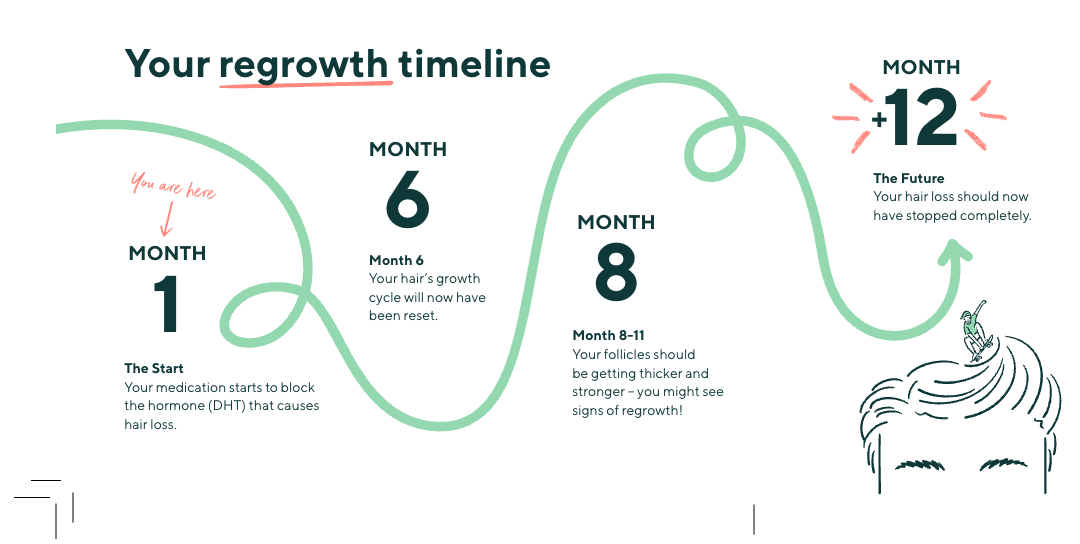
The sooner you start treatment after noticing hair loss, the better your chances of success. Results typically appear within 3-6 months, though it usually takes around 12 months to reach the maximum effectiveness.
How long should I take it for?
You’ll need to take your medication continuously to maintain the results. Here’s what you should know:
- Timeline: Some men notice stabilisation of hair loss within 3–6 months, but the best results typically appear after 12–24 months.
- Ongoing use: This treatment works for as long as you take it. If you stop, DHT levels will rise again, and hair loss will typically resume.
- Any hair that is regrown or strengthened by using minoxidil also requires continuous treatment to maintain the results.
What are the side effects?
Topical minoxidil is generally a very safe medication. Serious side effects are rare, since only a small amount of the medication is absorbed through the scalp.
However it’s important you understand what to look out for. Stop using this treatment plan and talk to a clinician if you experience any of the following symptoms.


Similarly, finasteride is a highly effective treatment with a strong safety profile. In clinical trials, the vast majority of men were able to use finasteride without side effects getting in the way of results.
However, all medications have potential side effects. Stop taking the medication and consult a clinician if you experience any of these symptoms.
Allergies
If you are allergic to finasteride, minoxidil, or any other ingredient in the spray, do not use this medication.
Signs of an allergic reaction include rash, itching, swelling of the face, lips, tongue, or throat, difficulty breathing, or feeling faint.
In severe cases this can progress to anaphylaxis, which is a medical emergency. If you experience any of these symptoms after taking your medication, call 999 or go to A&E immediately.
If you feel seriously unwell or experience severe or persistent side effects, please seek immediate medical attention by going to your local Accident & Emergency department or calling 999 in an emergency.
We want the best for you and your health. It is important that you don’t feel alone, so please voice your concerns and get in touch with one of our team members for more help if you need it. You can message a clinician via the live messaging function on your patient account.
If you’d like to speak with a clinician, please call our side effects support line on 020 4538 8411 (Mon-Fri, 09:00–17:00), and you’ll be able to connect with a clinician within minutes.
You can also report side effects through the government’s Yellow Card scheme at https://yellowcard.mhra.gov.uk/. This helps to improve medication safety for everyone.
Why am I Shedding?
Temporary hair shedding may occur in the first few weeks of treatment. This is a normal part of the process and indicates that the medication is doing its job. Treatment shifts hair follicles into a new growth cycle, causing older hairs to shed before new ones come through. It typically resolves within 2–8 weeks.
When will I see the Results?
It's natural to be eager for results, but it's crucial to understand that success takes time.
Minoxidil and finasteride will start working as soon as you start applying the spray, but visible results won’t appear immediately. While early signs may appear within 3-6 months, we recommend committing to the treatment plan for 12 months to fully appreciate its effects.
Keep in mind, restoring hair isn't a quick fix - it's a journey that requires patience and persistence.
Who should not take it?
This treatment plan is not suitable for women. The liquid must not be directly handled by females who could be pregnant or breastfeeding, due to the potential harm it may cause to a developing baby.
Since the medication is applied to the skin, those with scalp conditions or inflammation should not use the all-in-one spray.
Finasteride is not suitable for patients who:
- Currently take a 5-alpha reductase inhibitor for benign prostate enlargement (such as finasteride 5mg or dutasteride)
- Have or have previously had male breast cancer or prostate cancer
- Have galactose intolerance, Lapp lactase deficiency, or glucose-galactose malabsorption
- Have chronic liver disease
- Have a partner that is pregnant or trying to conceive
- Have an allergy to Finasteride
Minoxidil should not be used by patients who have:
- Chest pain or any heart rhythm abnormalities
- Heart valve problems
- Disease of the heart muscles
- Phaeochromocytoma (a rare adrenal gland tumour)
- An allergy to minoxidil
Please keep your medication out of the reach of children and pets, as consumption of minoxidil can lead to significant harm.
Fertility and pregnancy information
Pregnancy:
Small traces of finasteride may be present in semen. While the amount following a 1mg dose is very small and there are no confirmed cases of birth defects in humans, we cannot rule out a theoretical risk to a developing baby. As a precaution, we advise using a condom during intercourse with a woman who is pregnant while taking finasteride.
Fertility:
On fertility, the evidence is limited - men planning to conceive have often been excluded from clinical trials. There have been reports of infertility or lower sperm quality in some men taking finasteride, though other health factors may have contributed in many of these cases.
Some studies have shown finasteride can affect sperm parameters, but this does not usually translate to infertility in practice, and sperm quality often normalises even with continued use.
If you are actively trying to conceive, we would advise pausing finasteride during this period. Even if the impact on fertility is likely to be small, introducing an additional variable during what can already be a complex process is best avoided. If you are undergoing fertility treatment or have a known low sperm count, this advice is even more important.
Mood alterations and depression
Mood alterations such as depressed mood, depression and, less frequently, suicidal thoughts have been reported in patients treated with finasteride.
If sexual dysfunction occurs, this may contribute to changes in mood, but can also occur without mood alterations. If you experience any of these symptoms, stop taking finasteride and contact a clinician for further medical advice as soon as possible.
Impact on other medications and tests
Finasteride has no significant known drug interactions. However, it can affect the results of PSA (prostate-specific antigen) testing, used to screen for prostate issues - if you are having this test, let your doctor know you are using finasteride so they can interpret the results correctly.
Minoxidil can interact with blood pressure-lowering medications, potentially causing a greater drop in blood pressure. This is very unlikely to occur when using topical minoxidil.
If you start any new medications, or have any changes in your medical history, please let us know. You can also download a letter from your account page to share with your GP, ensuring they have all the relevant details about your treatment.