

Starting treatment is a big step towards taking control of hair loss, and taking a few minutes to read this guide will help you get the most out of it. Understanding how your treatment works, what to expect and how to use it properly will help you get the best results. Rest assured, you’re not alone on this journey - our team is here to support you every step of the way.
Hair restoration is a process that takes time and consistency. For most men, this is at least a 12-month commitment, but it’s worth it. Most patients see significant improvements with patience, whether it’s slowing hair loss, keeping the hair they have or regrowing some of what was lost.
Stay the course, and if you have any questions or concerns, just reach out - we’re here for you.

Is it possible to treat hair loss?
It’s a common myth that nothing can be done about hair loss, but the truth is, science disagrees! In fact, around 90% of men with male pattern baldness (MPB) respond positively to treatment. Dutasteride should stop the progression of hair loss entirely for most men, as well as promoting significant regrowth and better density.
How does Dutasteride work?
Male pattern baldness is caused by a hormone called DHT (dihydrotestosterone), which gradually shrinks hair follicles. Over time, this leads to thinner hair, a shorter growth cycle, and eventually, hair loss.
Dutasteride blocks the conversion of testosterone into DHT, reducing its levels in the scalp. This protects hair follicles from damage, slows down hair loss, and helps more hairs stay in the growth phase for longer.
Will Dutasteride work for me?
Dutasteride is the most effective medication for treating the root cause of hair loss, since it can reduce DHT levels by around 90%. The vast majority of men will see noticeable improvement in hair density from using Dutasteride, as well as stopping the progression of hair loss long term.
Results may be more limited when treating more advanced stages of hair loss, especially in areas of the scalp that are completely smooth where there is very limited potential for regrowth.
When and how is it taken?
For the best results, it is important to take your medication consistently according to the following instructions:
- Take ONE capsule each day with or without food.
- If you forget a dose - do not take a double dose to compensate for it.
Keep this medicine out of the sight and reach of children. Women who are pregnant or may become pregnant must not use or handle this medication. For oral use only. Do not use this medicine after the expiry date stated on the label.
How long should I take it for?
You’ll need to take your medication continuously to maintain the results. Here’s what you should know:
- Timeline: Some men notice stabilisation of hair loss within 3–6 months, but the best results typically appear after 12–24 months.
- Ongoing use: This treatment works for as long as you take it. If you stop, DHT levels will rise again, and hair loss will typically resume.
Think of this as a long-term plan to stabilise and manage hair loss, with the added potential for regrowth.
What are the side effects?
Side effects are a possibility with any medication, so it's crucial to be mindful of them. Dutasteride is a highly effective treatment with a strong safety profile. In clinical trials, the vast majority of men were able to use Dutasteride without side effects getting in the way of results.
However, all medications have potential side effects. Stop taking the medication and consult a clinician if you experience any of the following:


Allergies
If you are allergic to dutasteride or any other ingredient in the capsule, do not take this medication.
Signs of an allergic reaction include rash, itching, swelling of the face, lips, tongue, or throat, difficulty breathing, or feeling faint.
In severe cases this can progress to anaphylaxis, which is a medical emergency. If you experience any of these symptoms after taking your medication, call 999 or go to A&E immediately.
If you feel seriously unwell or experience severe or persistent side effects, please seek immediate medical attention by going to your local Accident & Emergency department or calling 999 in an emergency.
We want the best for you and your health. It is important that you don’t feel alone, so please voice your concerns and get in touch with one of our team members for more help if you need it. You can message a clinician via the live messaging function on your patient account.
If you’d like to speak with a clinician, please call our side effects support line on 020 4538 8411 (Mon-Fri, 09:00–17:00), and you’ll be able to connect with a clinician within minutes. A clinician can make small adjustments to your treatment plan to help you resolve your symptoms.
You can also report side effects through the government’s Yellow Card scheme at https://yellowcard.mhra.gov.uk/. This helps to improve medication safety for everyone.
When will I see results?
It's natural to be eager for results, but it's crucial to understand that success takes time.
Dutasteride gets to work as soon as you start taking it, but visible results might not appear immediately. While some early signs can surface within six months, we recommend committing to the treatment plan for at least a year to fully appreciate its effects.
Keep in mind, restoring hair isn't a quick fix — it's a journey that requires patience and persistence.
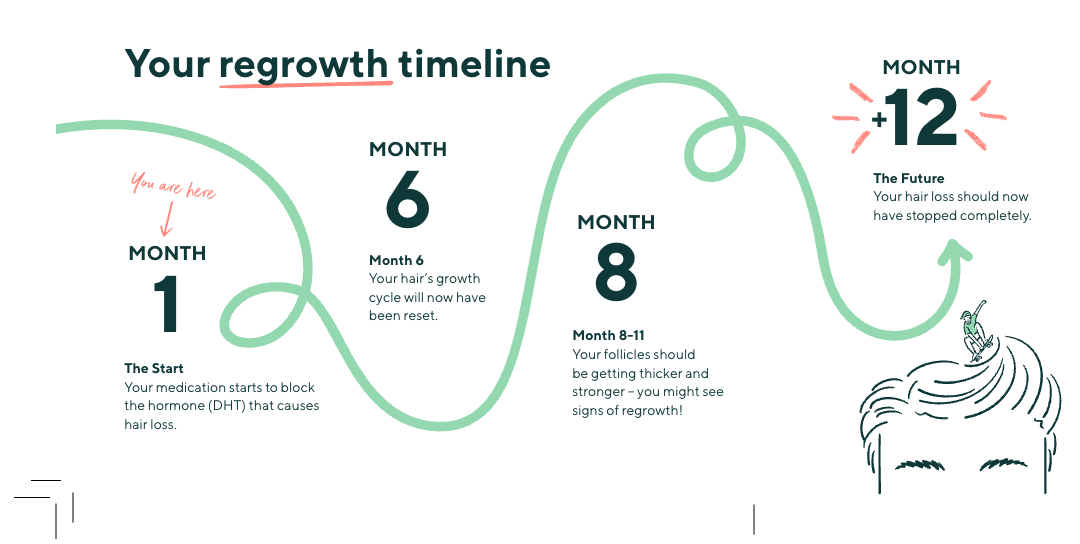
NOTE: Temporary hair shedding may occur in the first few weeks of treatment. This is a normal part of the process - treatment shifts hair follicles into a new growth cycle, causing older hairs to shed before new ones come through. It typically resolves within 2–8 weeks.
Who should not take it?
Dutasteride is not suitable for women, or for men under 18 years of age. These capsules must not be directly handled by females who could be pregnant or breastfeeding. This is due to the potential harm it may cause to a developing baby.
Dutasteride is not suitable for patients who:
- Currently take a 5-alpha reductase inhibitor for benign prostate enlargement (such as finasteride 5mg or dutasteride)
- Have or have previously had male breast cancer or prostate cancer
- Have galactose intolerance, Lapp lactase deficiency, or glucose-galactose malabsorption
- Have chronic liver disease
- Have a partner that is pregnant or trying to conceive within the next six months
- Have an allergy to Dutasteride
Do not use this treatment if you have an allergy to Dutasteride or any other components within the capsules. Additionally, our treatments are not suitable for men experiencing total hair loss.
Fertility and pregnancy information
Pregnancy:
Small traces of dutasteride may be present in semen. While the amount is very small and there are no confirmed cases of birth defects in humans, we cannot rule out a theoretical risk to a developing baby. As a precaution, we advise using a condom during intercourse with a woman who is pregnant while taking dutasteride.
Fertility:
Some studies have shown dutasteride can affect sperm parameters. This is reversible on discontinuing the medication, and sperm quality often improves even with continued use.
If you are actively trying to conceive, we would advise pausing dutasteride during this period. Even if the impact on fertility is likely to be small, introducing an additional variable during what can already be a complex process is best avoided. If you are undergoing fertility treatment or have a known low sperm count, this advice is even more important.
Mood alterations and depression
Mood alterations such as depressed mood, depression and, less frequently, suicidal thoughts have been reported in patients treated with medications in the same class as dutasteride.
If you experience any of these symptoms, stop taking dutasteride and contact a clinician for further medical advice as soon as possible.
Impact on other medications and tests
Dutasteride can interact with some medications. If you take any of the medications in this list, please notify a clinician as we may consider adjusting your dose of dutasteride:
Antiviral medications - Atazanavir, Cobicistat, Darunavir, Fosamprenavir, Letermovir, Lopinavir, Ritonavir
Antifungal medications - Fluconazole, Isavuconazole, Itraconazole, Ketoconazole, Posaconazole, Voriconazole
Antibiotics - Clarithromycin, Erythromycin
Heart medications - Diltiazem, Dronedarone, Verapamil
Other medications - Aprepitant, Berotralstat, Ceritinib, Crizotinib, Fedratinib, Idelalisib, Imatinib, Netupitant, Nilotinib, Tucatinib
Dutasteride can also affect the results of PSA (prostate-specific antigen) testing, used to screen for prostate issues - if you are having this test, let your doctor know you are taking dutasteride so they can interpret the results correctly.
If you start any new medications, or have any changes in your medical history, please let us know. You can also download a letter from your account page to share with your GP, ensuring they have all the relevant details about your treatment.