
Hair loss

Does minoxidil work?

Minoxidil is one of the main approved hair loss treatments. But how effective is it?

iconUpdated 10th November 2025

If you’re worried about your hairline, you’re not alone. Most men will experience hair loss at some point in their lives.

Minoxidil is one of the main treatments for it. But does it really work? Read on to find out.

Key Takeaways

  • Minoxidil promotes hair growth by increasing blood flow to your hair roots
  • It works for most people: in studies, 59-82% of people saw an improvement
  • Usually, it takes around a year to see maximum results
How does minoxidil work?

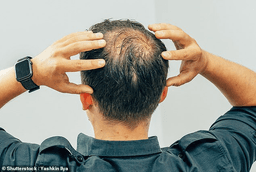
Your hair follows a natural cycle of growth and shedding. When you start to lose your hair, the growth phase gets shorter and your follicles start to shrink. Your hairs grow shorter and finer until the follicles close up altogether and hairs stop coming out.

Minoxidil encourages hair growth by increasing blood flow to your hair roots. This is thought to prolong the growth phase.

Heads up: Minoxidil is available as tablets or as a topical treatment (a spray or foam) you apply to your scalp. The topical version is licensed for male hair loss and is sold under the brand name Regaine. And it’s available at MANUAL.

The tablets are licensed for high blood pressure but are sometimes used off-label for hair growth.

How long does minoxidil take to work?

It usually takes around six months for topical minoxidil to have an effect. Though it can take a year to see maximum results.

Good to know: Some people notice an increase in hair shedding when they first start minoxidil. This usually resolves within six weeks.

Ready to regain your confidence?
Take the hair quiz today and we’ll recommend a treatment plan designed to stop hair loss and power regrowth.

Minoxidil results: What to expect

So, does minoxidil work? Yes, it does. Here’s what the research says:

  • Topical minoxidil causes hair regrowth on both the front and crown of the head, with results peaking after a year
  • Higher-strength topical minoxidil (5%) led to 45% more hair regrowth than a 2% dose. Men using the 5% dose also saw results sooner.
  • In a review of 27 studies (including a total of 2,933 people), oral minoxidil improved hair loss symptoms in 82% of people. Thirty-five percent saw a significant improvement.
  • Even at low doses, oral minoxidil can drive improvements in hair diameter and density.
  • Minoxidil foam can increase hair density, width, and scalp coverage on both the front and crown of the head.

Does minoxidil work forever?

There will come a time when your results will plateau. Usually, this is around the 12-month mark of using minoxidil. But staying on the medicine will help maintain your results.

Minoxidil isn’t a “cure” for male pattern baldness—it doesn’t treat the root cause (your genes). Rather, it prevents hair loss while you’re taking it. So, if you come off minoxidil, your hair loss will progress as it would naturally.

Not sure what’s best for you? Our team of clinicians and hair experts can advise on long-term hair loss treatments. Take our quiz to get started.

Discover hair loss treatments
Struggling with thinning hair or a receding hairline? Our exclusive, science-backed formulas are proven to slow down hair loss and help regrowth.
icon
Trusted by over 500,000 men
icon
Science-backed formulas you can’t get elsewhere
icon
Effective in 9 out of 10 men using our combined approach

Does minoxidil work for everyone?

It works for most people. Studies estimate that it’s effective in 59-82% of men dealing with hair loss.

Minoxidil is meant for men aged 18-65 who are experiencing male-pattern hair loss, aka hereditary hair loss. It can be prescribed for men over the age of 65, if the benefits outweigh the risks or side effects, after a clinical review (this is called off-label prescribing)

You shouldn’t take it if you have:

  • Sudden or patchy hair loss. Hereditary loss usually recedes at the temples, then the crown. Sudden or uneven loss needs medical assessment first.
  • Scalp disease or broken skin if using topical minoxidil. Conditions like psoriasis, severe dermatitis or infection can worsen.
  • Long-standing complete baldness. Minoxidil needs active follicles to work.
  • Uncontrolled blood pressure, whether it’s too high or too low.
  • Recent cardiovascular events: Heart attack, stroke or mini-stroke within the last 6 months.

If you’re keen to give minoxidil a try, we’ve got you. Take our quiz to find out which scientifically-proven treatment is best. Then, our team of experts will put together a personalised plan to get your hair back.

FAQ

Does minoxidil work? FAQ

DisclaimerAt MANUAL, we ensure that everything you read in the Health Centre is medically reviewed and approved. However, the information provided is not meant to replace professional medical advice, diagnosis, or treatment. It should not be relied upon for specific medical advice.
References
icon¹

Chen, Li, et al. “The Efficacy and Safety of Finasteride Combined with Topical Minoxidil for Androgenic Alopecia: A Systematic Review and Meta-analysis,” Aesthetic Plastic Surgery,scribble-underline vol. 44, 2020:962-970 https://link.springer.com/article/10.1007/s00266-020-01621-5.

icon²

Gupta, A K., et al. “Minoxidil: a comprehensive review,” Journal of Dermatological Treatment,scribble-underline vol. 33, issue 4, 2022:1896-1906 https://www.tandfonline.com/doi/10.1080/09546634.2021.1945527.

icon³

Gupta, A K., et al. “There is a Positive Dose-dependent Association Between Low-dose Oral Minoxidil and its Efficacy for Androgenetic Alopecia: Findings from a Systematic Review with Meta-regression Analyses,” Skin Appendage Disordersscribble-underline, vol. 8, issue 5, 2022:355-361 https://pmc.ncbi.nlm.nih.gov/articles/PMC9485924/.

icon

Hu, Ruiming, et al. “Combined Treatment with Oral Finasteride and Topical Minoxidil in Male Androgenetic Alopecia: a Randomized and Comparative Study in Chinese Patients,” Dermatologic Therapyscribble-underline, vol. 28, issue 5, 2015:303-308 https://onlinelibrary.wiley.com/doi/abs/10.1111/dth.12246.

icon

Hussein, Ramadan S., et al. “Applications and Efficacy of Minoxidil in Dermatology,” Skin Health and Diseasescribble-underline, vol. 4, issue 6, 2024:e472 https://pmc.ncbi.nlm.nih.gov/articles/PMC11608877/.

icon

Kanti, V., et al. “Effect of Minoxidil Topical Foam on Frontotemporal and Vertex Androgenetic Alopecia in Men: a 104-week Open-label Clinical Trial,” Journal of the European Academy of Dermatology and Venereologyscribble-underline, vol. 30, issue 7, 2015:1183-1189 https://onlinelibrary.wiley.com/doi/10.1111/jdv.13324.

icon

Liu, Chang, et al. “Efficacy and Safety of Oral Minoxidil in the Treatment of Alopecia: A Single-arm Rate Meta-analysis and Systematic Review,” Frontiers in Pharmacologyscribble-underline, vol. 16 2025:1556705 https://pmc.ncbi.nlm.nih.gov/articles/PMC12188453/.

icon

Mirmirani, P., et al. “Similar Response Patterns to 5% Topical Minoxidil Foam in Frontal and Vertex Scalp of Men with Androgenetic Alopecia: A Microarray Analysis,” British Journal of Dermatologyscribble-underline, vol. 172, issue 6, 2015: 1555-1561 https://academic.oup.com/bjd/article-abstract/172/6/1555/6615840?redirectedFrom=fulltext.

icon

“Minoxidil 5% w/v Cutaneous Spray, Solution,” Electronic Medicines Compendiumscribble-underline, 2024 https://www.medicines.org.uk/emc/files/pil.100306.pdf. Accessed 27 Oct. 2025.

icon¹⁰

“Minoxidil for Hair Loss,” Gloucestershire Hospitals NHS Foundation Trust, https://www.gloshospitals.nhs.uk/your-visit/patient-information-leaflets/minoxidil-for-hair-loss-ghpi1649/ Accessed 27 Oct. 2025.

icon¹¹

“How Common is Male Pattern Hair Loss?”, National Institute for Health and Care Excellencescribble-underline, 2022. https://cks.nice.org.uk/topics/male-pattern-hair-loss-male-androgenetic-alopecia/background-information/prevalence/. Accessed 27 Oct. 2025.

icon¹²

Olsen, E A., et al. “A Randomized Clinical Trial of 5% Topical Minoxidil Versus 2% Topical Minoxidil and Placebo in the Treatment of Androgenetic Alopecia in Men,” Journal of the American Academy of Dermatologyscribble-underline, vol. 47, issue 3, 2002:377-385 https://pubmed.ncbi.nlm.nih.gov/12196747/.

icon¹³

Olsen, E A., et al. “Five-year Follow-up of Men with Androgenetic Alopecia Treated with Topical Minoxidil,” Journal of the American Academy of Dermatologyscribble-underline, vol. 22, issue 4, 1990:643-646 https://www.jaad.org/article/0190-9622(90)70089-Z/abstract.

icon¹⁴

Suchonwanit, Poonkiat, et al. “Minoxidil and Its Use in Hair Disorders: A Review,” Drug Design, Development and Therapyscribble-underline, vol. 13, 2019:2777-2786 https://pmc.ncbi.nlm.nih.gov/articles/PMC6691938/.

icon¹⁵

Wall, Dmitri, et al. “Advances in Hair Growth,” Faculty Reviewsscribble-underline, vol. 11, 2022:1 https://pmc.ncbi.nlm.nih.gov/articles/PMC8808739.

We use cookies to analyse data and personalise your visit, learn more in our privacy policy